
How to Identify Safe Crypto Casinos in 2026
Crypto casinos are growing fast, but not every platform deserves trust. Many sites look polished on the surface. However, a clean homepage, a large game lobby, or a flashy bonus does not prove that a casino is safe. What matters is how the platform handles licensing, payments, data security, fairness, and withdrawals when real money is involved.
That is where many players make the wrong decision. They judge a crypto casino by design, promotions, or speed of registration. In reality, safety comes from deeper operational signals. A trustworthy casino shows clear licensing details, explains its verification standards, offers transparent payment rules, and works with known software providers. More importantly, it does not hide critical information in vague terms and conditions.
The crypto gambling market adds another layer of complexity. Traditional online casino checks still matter, but crypto also brings wallet security, blockchain payment handling, and faster cross-border deposits into the picture. That means players need to think beyond welcome bonuses and start evaluating the full risk profile of a casino before they sign up.
A safe crypto casino should make the most important information easy to verify. Players should be able to confirm who operates the site, what license it uses, how withdrawals are processed, which currencies it supports, and whether gameplay is backed by established providers or provably fair systems. If a platform avoids these basics, the problem is usually deeper than poor presentation.
This is also why serious comparison and research matter before depositing funds. Instead of relying on random ratings or anonymous comments, players should use structured review frameworks that examine trust signals properly. A strong starting point is understanding how secure gambling platforms are evaluated through factors like licensing, payment transparency, and operational reliability, which are covered in guides such as the Safe Online Casino Guide and the Casino Security Guide.
In this guide, we break down how to identify safe crypto casinos in 2026, what trust signals matter most, and which warning signs should make players walk away before they risk a deposit.
What Makes a Crypto Casino Safe?
Safety in crypto gambling is not based on a single feature. It comes from a combination of legal, technical, and operational standards working together. A platform may offer Bitcoin deposits and fast sign-up, but that alone says nothing about whether it protects users properly.
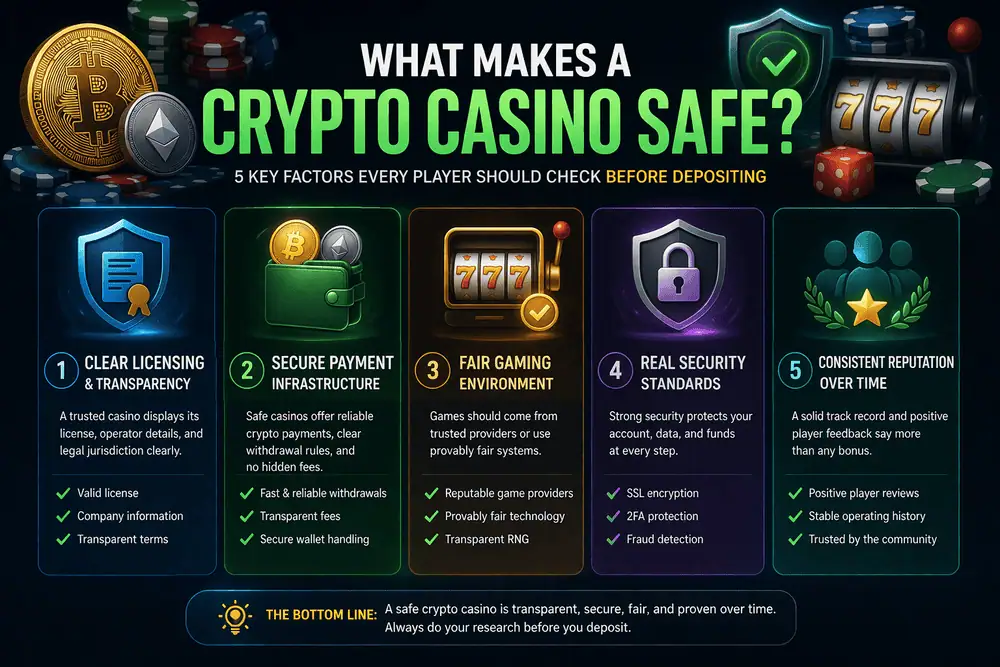
The safest crypto casinos usually perform well in five core areas:
1. Clear Licensing and Operator Transparency
A serious casino should clearly show its licensing information and company background. That includes the operator name, licensing jurisdiction, and terms that explain which entity is responsible for the platform. When this information is missing, hidden, or inconsistent, trust drops immediately.
A license does not make every casino perfect, but it creates a basic accountability layer. It shows that the operator is not running an entirely anonymous platform with no formal oversight. Players should also pay attention to whether the site explains dispute procedures, restricted countries, and compliance rules in a transparent way.
2. Secure Payment Infrastructure
Payment security matters just as much as game selection. A reliable crypto casino should process deposits accurately, support stable wallet handling, and explain withdrawal procedures clearly. The best platforms also separate promotional language from actual cashout conditions. That prevents confusion later.
Fast deposits mean very little if withdrawals become delayed, manually reviewed without explanation, or limited by unclear rules. This is why payment transparency remains one of the strongest trust indicators in the industry.
3. Fair Gaming Environment
Game fairness is another major signal. Safe platforms usually work with established providers or use provably fair systems for in-house games. Players should be able to identify who supplies the games, how results are generated, and whether the platform explains fairness mechanisms in a way that can be checked.
If a casino offers mostly unknown games with little provider information, caution is justified. A trustworthy platform does not make players guess where the games come from.
4. Real Security Standards
A secure casino should protect accounts and transactions through basic but essential safeguards. That includes SSL encryption, strong login protection, responsible wallet processing, and internal fraud controls. While players do not always see every layer, the platform should still communicate security standards clearly.
Trustworthy casinos also tend to provide better documentation around verification, suspicious activity checks, and account protection. That level of clarity separates serious operators from platforms focused only on short-term deposits.
5. Consistent Reputation Over Time
A casino’s long-term reputation often reveals more than its marketing. Players should look at whether the platform has maintained a stable presence, built a track record for paying users, and earned recognition through structured reviews instead of hype alone.
That does not mean every complaint is a red flag. Every large platform receives complaints. The key question is whether the issues follow a pattern. Repeated problems with withdrawals, account closures, missing support, or rule changes should never be ignored.
Why Licensing Alone Is Not Enough
Many players stop their research as soon as they see a license badge in the footer. That is a mistake. A license is important, but it is only one part of the safety picture. Some casinos use licensing as a trust shortcut while still performing poorly in customer support, verification handling, or withdrawal transparency.
A safer approach is to treat licensing as the first filter, not the final answer.
For example, players should still ask:
- Does the casino explain its withdrawal rules clearly?
- Are the payment methods transparent?
- Are game providers recognizable?
- Is the operator identity visible?
- Are terms written clearly or filled with vague language?
- Does the platform have a stable reputation beyond bonus advertising?
This is where broader research becomes useful. A quality review process looks at how a casino operates in practice, not just which badge appears in the footer. That is also why platforms that compare casinos through methodology, category structure, and trust-based review standards can be more useful than simple ranking lists. In that context, players who want to compare platforms more deeply can review how CasinoIndex’s global casino directory approaches casino discovery and structured research.
Red Flags That Indicate a Risky Crypto Casino
Knowing what makes a casino safe is only half the equation. Players also need to recognize warning signs early. Most risky platforms reveal problems long before withdrawals fail. The signals are usually visible in how the casino explains rules, handles support, or structures its payment policies.
The biggest mistake players make is ignoring small warning signs because deposits work smoothly. Almost every casino makes deposits easy. The real test starts when players examine withdrawal rules, account policies, and transparency.
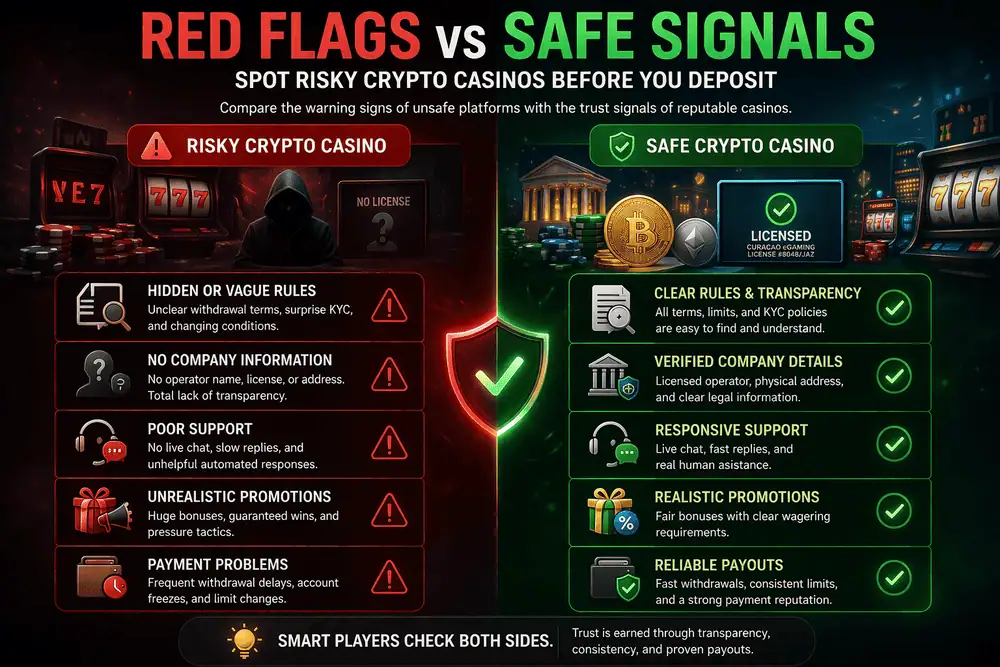
These are some of the most common red flags experienced players look for:
Hidden or Vague Withdrawal Rules
Unclear withdrawal conditions are one of the strongest danger signals. Risky casinos often hide important limits deep inside their terms or use confusing language around processing times.
Warning signs include:
• Withdrawal limits that only appear after depositing
• Manual reviews with no clear timeline
• Sudden KYC requirements not mentioned earlier
• Bonus terms that block withdrawals unexpectedly
• Changing rules after large wins
Legitimate casinos explain payment rules before players deposit. They do not rely on surprise conditions later.
No Clear Company Information
A casino that hides its operator identity should always be treated carefully. Even crypto platforms should still disclose who runs the site. Transparency does not conflict with crypto philosophy. Professional operators still show legal ownership structures.
Warning signs include:
• No company name
• No licensing entity listed
• No legal address
• Generic support email only
• No responsible gambling policies
When a casino avoids basic identity disclosure, players should question what else is being hidden.
Poor Support Accessibility
Support quality often reveals how a casino operates internally. Safe platforms usually offer multiple support channels and reasonable response times. Risky platforms often hide support behind forms or bots that never resolve real issues.
Watch for:
• No live chat
• Delayed ticket responses
• Generic scripted replies
• No escalation process
• Support avoiding withdrawal questions
Support behavior often predicts how problems will be handled later.
Unrealistic Marketing Claims
Crypto casinos sometimes use aggressive marketing to attract deposits quickly. Extremely large bonuses, guaranteed wins, or unrealistic reward claims should always trigger caution.
Examples include:
• Guaranteed profit language
• “No risk gambling” claims
• Extreme bonus percentages without clear terms
• Pressure tactics like countdown deposits
• Promotions without wagering explanations
Serious casinos focus on realistic offers. They do not promise impossible outcomes.
Poor Payment Track Record
Payment complaints usually follow patterns. One delayed withdrawal does not define a casino. However repeated complaints about blocked withdrawals, unexplained delays, or sudden verification demands often indicate operational problems.
Players should pay attention to:
• Withdrawal complaints repeating over time
• Sudden account freezes after wins
• Payment limits that change unexpectedly
• Large withdrawal delays without explanation
Reliable casinos protect their payment reputation carefully because it directly affects trust.
How to Properly Research a Crypto Casino Before Depositing
Experienced players rarely trust first impressions. They follow a structured evaluation process before depositing funds. This reduces risk dramatically and helps avoid platforms that rely on marketing rather than operational quality.
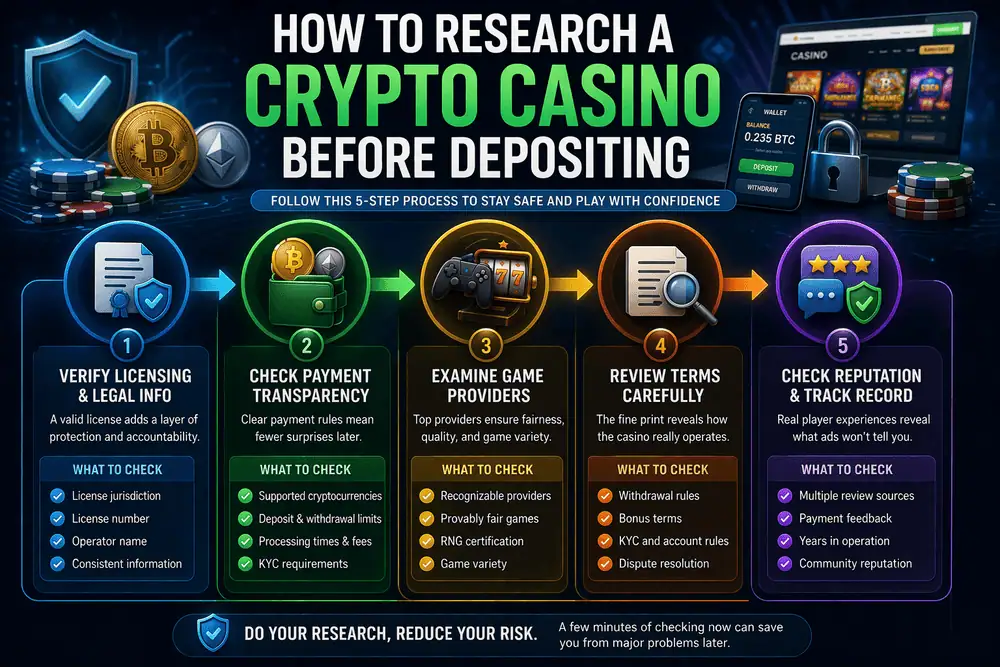
A simple research process usually follows these steps:
Step 1 — Verify Licensing and Legal Information
Start by checking whether the casino clearly states its license and operator. Confirm the jurisdiction and verify whether the information appears consistent across the site.
If licensing details are hard to find, that alone may justify choosing another platform.
Step 2 — Check Payment Transparency
Review deposit and withdrawal pages before registering. A reliable casino explains:
• Supported cryptocurrencies
• Processing times
• Withdrawal limits
• Verification triggers
• Fee structures
Clear payment documentation usually indicates operational maturity.
Players wanting deeper understanding of how crypto casino transactions function can also review broader explanations such as the crypto casino research frameworks discussed in the Crypto Casino Research Guide, which explains how infrastructure and payment models affect reliability.
Step 3 — Examine Game Providers
Check whether the casino lists known software providers. Platforms working with established developers usually maintain higher operational standards because providers require integration compliance.
If most games come from unknown studios with little documentation, players should investigate further.
Step 4 — Review Terms Before Depositing
Few players read terms until problems appear. Professionals do the opposite. They review key sections early:
Focus on:
• Withdrawal section
• Bonus restrictions
• Account closure rules
• Verification triggers
• Dormant account policies
Clear language is a positive sign. Overly complex wording may indicate risk.
Step 5 — Compare Multiple Sources
Never rely on a single opinion source. Look at structured reviews, technical comparisons, and trust-focused directories. The goal is not to find perfect casinos. It is to reduce uncertainty through multiple evaluation perspectives.
This approach reduces emotional decisions and replaces them with research-driven decisions.
Why Reputation Clusters Matter More Than Individual Reviews
Many players still judge casinos by individual user reviews. That approach rarely works. Individual experiences vary widely. A better approach is looking for reputation clusters.
A reputation cluster means identifying patterns across multiple evaluations rather than reacting to isolated complaints or praise.
For example:
One complaint about delayed withdrawal = normal
Ten complaints about delayed withdrawals = pattern
One positive review = limited signal
Consistent reputation across multiple reviews = stronger signal
This is why structured casino directories and research-based comparison platforms can offer more value than isolated comments. Methodology-driven platforms tend to evaluate licensing, payment structure, software providers, security practices, and long-term stability rather than emotional reactions.
Understanding this difference helps players avoid emotional decision making and instead focus on measurable trust signals.
How Serious Players Reduce Risk Long Term
Experienced crypto casino users rarely depend on luck when choosing platforms. Instead, they follow simple risk-reduction habits that dramatically lower the chance of problems later. These habits are not complicated, but they require discipline.
One of the most effective strategies is limiting exposure. Instead of keeping large balances on one platform, experienced players spread activity across trusted casinos. This reduces counter-party risk and protects funds if operational issues appear.
Another important habit is testing withdrawals early. Professionals often make a small deposit, place minimal gameplay, and then request a withdrawal test. This confirms whether payment processing works smoothly before larger balances are involved. If a casino processes small withdrawals reliably, confidence increases. If problems appear early, losses stay minimal.
Account security also plays a role. Using unique passwords, enabling two-factor authentication where available, and keeping personal wallets secure reduces avoidable risks. While platform security matters, user security habits matter just as much.
Documentation is another overlooked factor. Serious players track deposits, withdrawals, and account communication. If a dispute ever occurs, having records helps resolve problems faster.
Finally, experienced players avoid emotional decision making. Many problems start when players chase losses, trust unrealistic bonuses, or ignore warning signs because deposits were convenient. A research-first mindset consistently produces better long-term outcomes than impulse decisions.
The Role of Structured Casino Research Platforms
As the crypto casino space grows, the amount of information available to players continues increasing. That creates a new challenge. The problem is no longer lack of information. The problem is identifying which information is structured, reliable, and based on real evaluation criteria.
This is where research-driven casino directories provide value. Instead of focusing only on promotions, structured platforms categorize casinos based on features, payment models, security indicators, supported currencies, and operational characteristics. This allows players to compare platforms based on objective factors rather than marketing.
Directories that organize casinos through category filters, trust signals, and evaluation methodology allow users to research more efficiently. Players can compare crypto support, withdrawal speeds, verification policies, and game ecosystems without relying on guesswork.
For players wanting a structured starting point for research, platforms like CasinoIndex aim to organize global casino data into searchable categories rather than promotional lists. The idea behind structured directories is simple: reduce uncertainty by making operational information easier to compare.
Instead of replacing personal research, these platforms support it. Players still need to evaluate casinos individually. However structured directories can significantly reduce the time needed to identify serious platforms versus high-risk operators.
Final Thoughts: Safety Comes From Process, Not Promises
Safe crypto gambling does not depend on finding a perfect casino. No platform is perfect. Safety comes from understanding how casinos operate and making decisions based on verification rather than marketing.
Players who focus on licensing, payment transparency, provider quality, security standards, and reputation patterns usually avoid most problems seen in the crypto gambling space. Those who focus only on bonuses or fast registration often learn expensive lessons later.
The difference usually comes down to process. Players who follow a research process consistently experience fewer payment issues, fewer disputes, and better long-term experiences.
Crypto casinos will continue evolving as blockchain infrastructure improves. Payment speeds will increase. Wallet integrations will improve. New platforms will appear. But the fundamentals of safety will remain the same: transparency, operational clarity, and reputation consistency.
Players who understand these fundamentals will always have an advantage over those who rely only on advertising claims.
FAQ — Safe Crypto Casinos
How do I know if a crypto casino is legitimate?
Check licensing information, operator transparency, payment documentation, and software providers. Legitimate casinos usually make this information easy to verify. If basic operational details are missing, caution is justified.
Are crypto casinos safer than traditional online casinos?
They are not automatically safer. Crypto improves payment speed and privacy, but platform reliability still depends on how the casino operates. Licensing, security practices, and payment transparency still matter more than the payment method itself.
What is the biggest risk when using crypto casinos?
The biggest risk usually comes from choosing unverified platforms. Most problems happen when players deposit before checking withdrawal rules, operator background, or reputation patterns.
Should I always complete KYC before withdrawing?
Not always, but players should expect verification if withdrawal amounts increase or security checks trigger. Casinos that clearly explain verification triggers are usually more trustworthy than those that introduce unexpected requirements later.
Do provably fair games guarantee safety?
They guarantee game result transparency, not platform reliability. A casino can offer provably fair games and still perform poorly in payments or support. Fairness is only one part of overall safety.
Is it safer to use multiple casinos instead of one?
Risk diversification can reduce exposure. Many experienced players avoid keeping large balances on one platform. Testing multiple trusted casinos can reduce operational risk.
What licenses are considered trustworthy for crypto casinos?
Several licensing jurisdictions are commonly used in the crypto gambling industry. The most recognized include Curacao, Malta (MGA), Isle of Man, and Gibraltar. Each operates under different regulatory standards, but the key factor is not just the license name. What matters more is whether the casino clearly displays its license number, regulatory authority, and operator entity.
A trustworthy casino should also maintain consistent licensing information across its terms, footer, and legal pages. If details differ between sections, that can indicate poor operational control.
Licensing alone should never be the only safety factor. Payment reliability, security procedures, and reputation patterns remain equally important.
How important is withdrawal speed when evaluating a crypto casino?
Withdrawal speed is often one of the most accurate trust indicators. While deposits are almost always instant, withdrawals reveal how a casino actually operates. Fast withdrawals usually indicate strong liquidity management and efficient payment processing systems.
However speed alone is not everything. Players should also evaluate:
• Consistency of withdrawals
• Transparency of limits
• Manual review processes
• Fee clarity
• Processing communication
A casino that explains why a withdrawal takes time is usually safer than one that processes payments fast but provides no documentation.
Can a crypto casino change withdrawal rules after I win?
Legitimate casinos should not change rules retroactively. However some platforms rely on vague terms to create flexibility around withdrawal handling. This is why reading withdrawal sections before depositing is critical.
Players should especially review:
• Maximum withdrawal limits
• Bonus withdrawal restrictions
• Verification requirements
• Dormant account rules
• Account review triggers
Clear rules reduce disputes. Unclear rules create them.
Should I trust new crypto casinos?
New casinos are not automatically unsafe, but they require more caution. Without operational history, players cannot evaluate long-term payment behavior or dispute handling patterns.
Safer ways to evaluate new platforms include:
• Testing small deposits
• Checking provider partnerships
• Reviewing payment documentation
• Verifying licensing consistency
• Looking for technical transparency
Time is one of the strongest trust builders in the casino industry. Platforms that operate consistently for years usually present lower risk than new operators with aggressive marketing.
Are anonymous crypto casinos more risky?
Anonymity in crypto does not automatically mean risk. However completely anonymous operators with no company disclosure increase uncertainty. Professional platforms usually balance crypto privacy with operational transparency.
Players should distinguish between:
User privacy → normal
Operator anonymity → potential risk
If the operator identity is completely hidden, players should evaluate other trust signals carefully before depositing.
How important are game providers when evaluating casino safety?
Game providers are often overlooked as a trust indicator. Established providers usually require technical integration standards and compliance checks. Casinos working with known developers often meet higher operational standards than those using unknown studios.
Players should check whether the casino lists recognizable providers and whether those providers appear across multiple trusted platforms.
Provider diversity can also indicate platform maturity. Casinos with multiple provider partnerships usually have stronger infrastructure than those offering only internal games.
What role does provably fair technology play?
Provably fair systems allow players to verify game outcomes through cryptographic verification. This increases transparency in game results, particularly for dice, crash, and card-based games.
However provably fair does not guarantee:
Payment reliability
Customer support quality
Withdrawal consistency
Operator integrity
It improves game fairness but should always be evaluated alongside operational trust factors.
How can players protect themselves from account restrictions?
Players can reduce the risk of account issues by following simple practices:
• Use accurate registration details
• Avoid multiple accounts
• Follow bonus rules carefully
• Keep transaction records
• Avoid VPN usage if restricted
• Verify identity when requested
Many account disputes happen because players ignore terms rather than because casinos act unfairly.
Do large bonuses indicate risk?
Not always. However extremely large bonuses should always be examined carefully. The real question is not the bonus size but the wagering structure behind it.
Players should review:
• Wagering requirements
• Maximum withdrawal limits
• Game contribution percentages
• Bonus expiry timelines
Transparent bonus documentation usually indicates safer platforms. Hidden bonus rules often lead to disputes.
What is the safest way to test a new crypto casino?
A professional approach usually follows this sequence:
1 Small deposit test
2 Minimal gameplay
3 Withdrawal test
4 Support interaction test
5 Documentation review
This process allows players to evaluate payment handling, support responsiveness, and operational clarity before increasing exposure.