
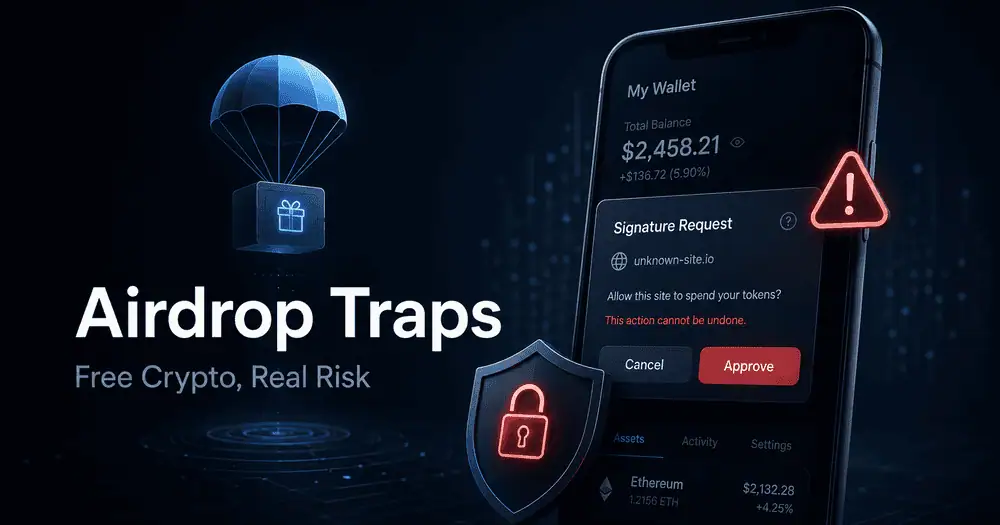
Excerpt: Free crypto can be useful, but fake claim pages, malicious approvals, and unclear wallet signatures can turn a simple airdrop into a costly mistake.
Crypto airdrops are one of the most popular ways for users to discover new blockchain projects, test early products, and receive token rewards without buying the asset first. That is why many users follow crypto airdrops closely and look for new campaigns before they become crowded.
The risk is that scammers understand the same psychology. A fake airdrop does not need to convince someone to invest. It only needs the user to click a claim link, connect a wallet, approve a contract, sign a message, or follow a fake support flow. The reward may look free, but the wallet action behind it can create real exposure.
That does not mean users should avoid airdrops. Legitimate campaigns can still help people discover projects early, test products, and receive rewards for activity. A safer approach treats every claim as a wallet-security decision before anything is connected, approved, or signed.
Why Airdrops Make Users Lower Their Guard
The word “free” changes how people behave. A user may research a token carefully before buying it, then rush through a claim if a page says an allocation is waiting. Fake airdrop campaigns rely on that shift. They turn urgency, eligibility, and community hype into a shortcut around normal wallet checks.
Airdrops also feel familiar. Real campaigns use claim windows, eligibility pages, task lists, allowlists, Discord roles, testnet activity, wallet snapshots, and social announcements. Scam campaigns copy the same patterns. They may use real project branding, fake screenshots, cloned accounts, countdown timers, bot replies, and comments from accounts pretending to be successful claimants.
The user is not always trying to take a big risk. Often, the mistake starts with a small action: checking eligibility, connecting a wallet, signing a message, or approving a contract that appears to be part of the claim. The scam works because the user is focused on the reward, not on the permission being requested.
What Is An Airdrop Trap?
An airdrop trap is a fake or manipulated reward flow that uses free tokens as bait. The danger is not always the token itself. The real risk may be the claim page, the approval request, the wallet signature, the fake support account, or the “verification” step that follows.
Some traps are obvious, such as a page asking for seed phrases or a direct payment to unlock funds. Others are more subtle. A claim button may trigger a wallet prompt that gives a contract permission over tokens already in the wallet. A “verify ownership” message may hide an action the user does not understand. A random spam token may appear in the wallet with a name or image that points to a scam site.
The safest mindset is simple: the reward is not the first thing to check. The wallet action is. A claim page can look polished, but the approval, signature, or contract interaction decides whether the user is actually taking on risk.
The Most Common Airdrop Traps
| Trap | What Users See | What Can Go Wrong |
| Fake claim page | A reward page using real project branding | The site pushes a harmful wallet action |
| Malicious approval | A prompt that looks like part of the claim | A contract may receive permission over tokens |
| Signature trap | “Sign to verify wallet ownership” | The user may authorize something they do not understand |
| Fake support DM | “We can help you claim” | The user is moved into a social-engineering funnel |
| Spam token | A random token appears in the wallet | The token name or image points to a scam link |
| Gas unlock request | “Send funds to activate the reward” | The user sends money directly to a scammer |
| Fake countdown | “Claim before the window closes” | Urgency pushes the user to skip verification |
| Fake migration | “Move old tokens to new tokens” | The page may request unsafe approvals or signatures |
The Approval Trap: When A Claim Gives A Contract Too Much Power
One of the most common airdrop risks is the approval prompt. A user may think they are only claiming a reward, but the wallet may be asking them to approve a smart contract. In some cases, that approval can give the contract permission to move certain tokens from the wallet.
The wallet prompt carries more weight than the claim page design. A professional-looking page can still ask for too much access. Users should be careful with unlimited approvals, approvals for unrelated assets, NFT collection approvals, and any prompt that does not match the action described on the page.
A simple rule helps: claiming a reward should not require broad spending power over valuable assets already sitting in the wallet. If a user has interacted with a suspicious claim, reviewing and removing malicious token approvals can reduce further exposure from permissions that should never have been granted.
The Signature Trap: When “Verify Wallet” Is Not Harmless
Some fake airdrop pages do not ask for an obvious approval. Instead, they ask the user to sign a message. The wording may look harmless: “verify ownership,” “confirm eligibility,” or “continue to claim.” The problem is that users often sign messages without understanding what the wallet is showing.
Not every signature does the same thing. Some signatures simply prove wallet ownership. Others can approve actions or interact with systems in ways the user did not expect. This is why transaction signing should be treated as a checkpoint, not a formality.
The safest habit is to slow down whenever a claim asks for a signature. If the message is unclear, if the site is not official, or if the wallet preview does not match the claim story, the reward can wait.
Free Coins Are Not Always Free
A free token is only free if the user does not give up something more valuable in the process. A claim can still cost gas, expose wallet permissions, create privacy concerns, complicate recordkeeping, or push the user into fake support channels. Some tokens are illiquid, worthless, or built mainly to lure users toward another unsafe action.
A claim that asks for broad permissions is not just a reward. A page that asks for wallet recovery words is not a claim. A random token that appears in a wallet is not proof that the user earned anything. The user should never ignore the wallet prompt because the page says the token is free.
Spam tokens are a good example. A wallet may display a token that the user never requested. The name, image, or transfer history may point to a claim site. The safest response is usually to ignore or hide the token, not to visit the link attached to it.
How To Check An Airdrop Before Connecting A Wallet
Before connecting a wallet, users should check the campaign path first. A safer routine starts with trusted listings, official project channels, matching domains, clear task instructions, and wallet prompts that match the action being described.
Users should avoid claim links from random DMs, replies, paid ads, fake support accounts, and copied social posts. They should check the domain carefully, confirm that the campaign appears on official project channels, and use a separate wallet for airdrop activity. A claim wallet should not hold long-term savings, valuable NFTs, or large balances.
Anyone new to campaigns should first understand how to participate in crypto airdrops before connecting a wallet to unfamiliar claim pages. The process is easier to judge when the user already understands tasks, eligibility, snapshots, wallet connections, and claim windows.
Wallet Prompts Carry More Weight Than Website Design
Scam pages can copy logos, colors, social posts, screenshots, and countdown timers. The website can look clean while the wallet prompt tells a different story.
The wallet prompt is the real checkpoint. If a page says “claim,” but the wallet asks for spending permission, the user should stop. If a page says “verify,” but the message is unreadable or unclear, the user should stop. If a page says “free,” but asks for payment to unlock funds, the user should stop.
Airdrop safety is not only about spotting ugly scam pages. Many risky pages look polished. The stronger habit is learning to question every approval, signature, and contract interaction before confirming it.
Why A Separate Airdrop Wallet Helps
A separate airdrop wallet does not make every claim safe, but it can reduce the damage if something goes wrong. The wallet used for campaigns should not hold long-term savings, valuable NFTs, or large balances. If an interaction turns out to be risky, the problem should not reach the user’s main holdings.
This approach also keeps airdrop activity cleaner. Users can separate campaign tasks, testnet actions, small balances, and claim interactions from their main storage wallet. The goal is not to become careless. The goal is to reduce the blast radius of a mistake.
A claim wallet should still be managed carefully. Users should avoid unnecessary approvals, disconnect suspicious sites, keep only the funds needed for gas or testing, and move valuable rewards away once they are received and verified.
What To Do If A Claim Looks Suspicious
If a claim page looks suspicious, the best move is to stop. A real campaign should not require users to rush through unclear prompts, send funds to unlock funds, enter recovery words, or accept broad permissions for unrelated assets.
If the user only clicked the page, they should close it and return through official channels. If they connected a wallet, they should disconnect the site from the wallet interface. If they approved something, they should review wallet permissions. If they signed an unclear message or interacted with a suspicious contract, they should avoid fake recovery links, fake support DMs, or “fix your wallet” tools.
Scams often continue after the first mistake. Fake support accounts may appear under posts, in Telegram groups, or in direct messages. Their goal is usually to push the user into another unsafe action.
A Simple Airdrop Safety Routine
- Start from trusted listings or official project channels.
- Avoid claim links in DMs, replies, and ads.
- Check the domain before connecting.
- Use a separate wallet for airdrops.
- Keep large balances away from claim wallets.
- Read every wallet prompt.
- Question approvals for unrelated assets.
- Do not sign unclear messages.
- Never enter a seed phrase.
- Never send funds to unlock funds.
- Hide random spam tokens instead of following links attached to them.
- Review permissions after risky interactions.
Airdrops can still be useful when users treat them like reward opportunities, not shortcuts around wallet security. The safer approach is simple: find campaigns through trusted routes, verify the claim source, use a limited wallet, read the prompt, and step away from any claim that asks for more access than a free reward should need.