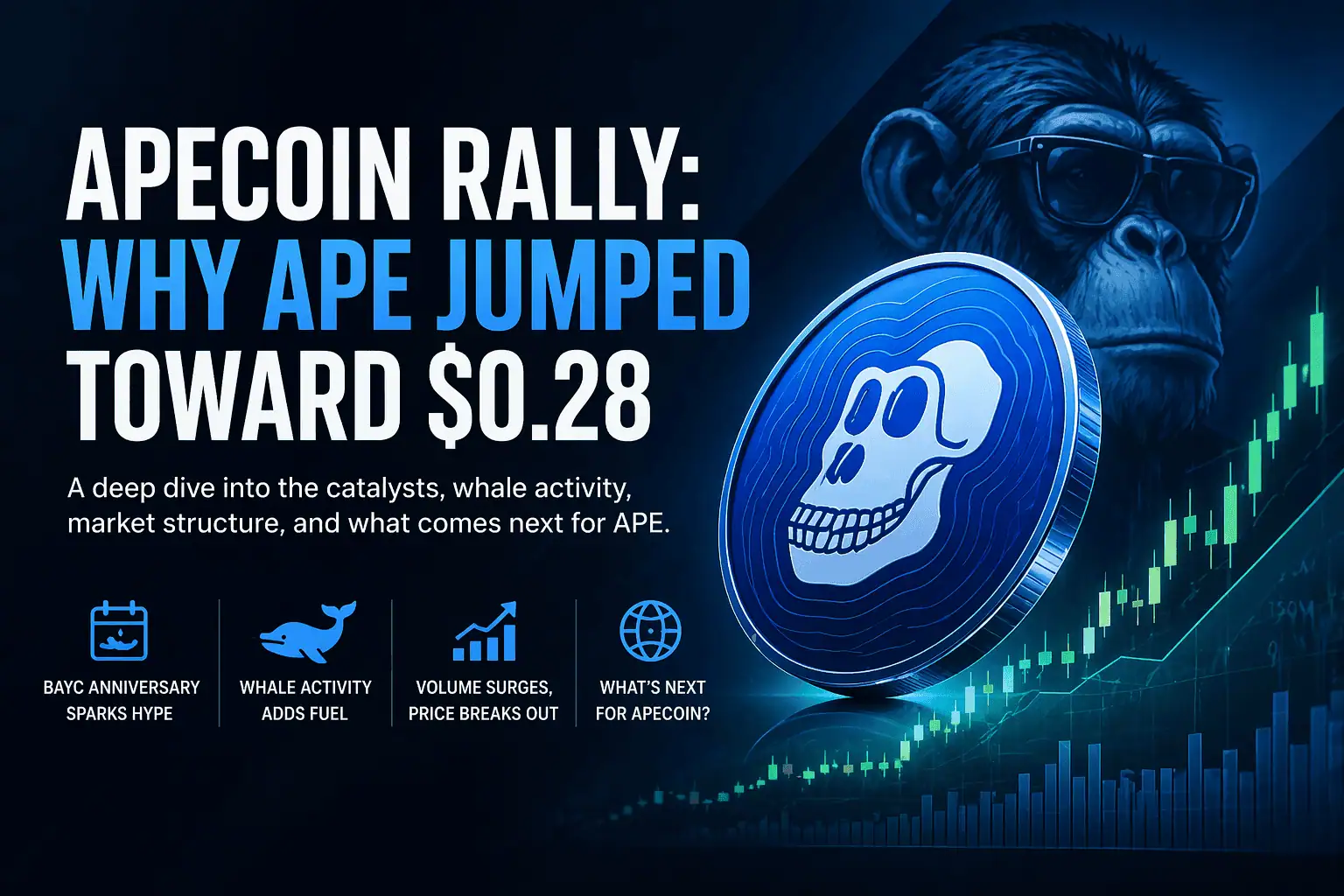
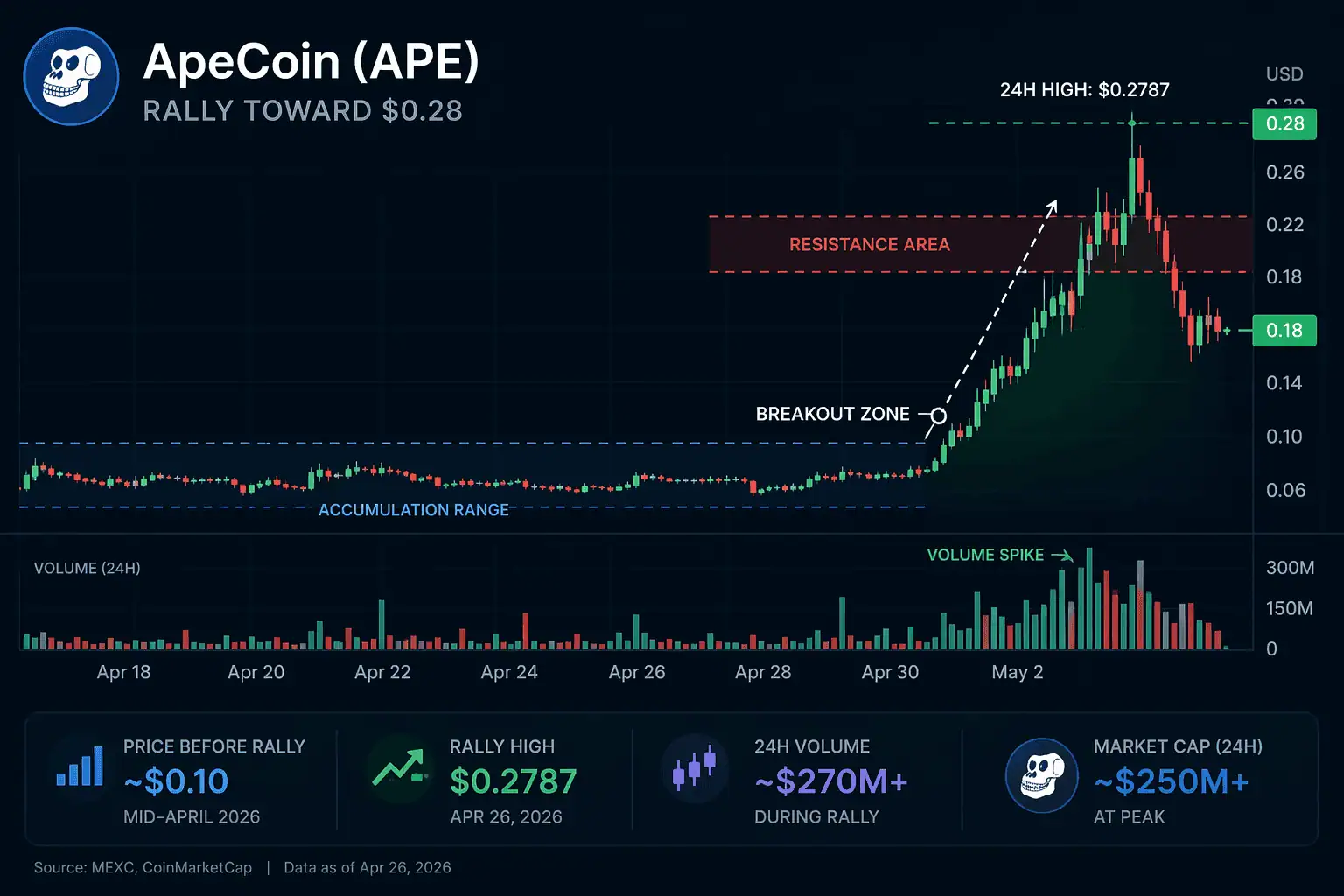
ApeCoin has returned to the market’s attention with a violent short-term rally that caught many traders off guard. After spending weeks near depressed price levels, APE suddenly moved from the low $0.10 range toward $0.28 on selected market feeds before cooling back into a lower range. MEXC showed a 24-hour trading range between roughly $0.1013 and $0.2787, while CoinGecko showed APE up more than 70% over 24 hours with heavy trading volume.
That kind of move always needs context. APE did not rise because the entire market suddenly decided the token had solved its long-term utility problem. It rose because several short-term forces hit at the same time: Bored Ape Yacht Club attention, renewed Yuga Labs headlines, whale positioning, social momentum, and a deeply compressed chart structure.
This is important because ApeCoin is not a normal altcoin. It trades with a different emotional profile. It carries the history of the NFT boom, the collapse in NFT floor prices, the decline of metaverse hype, and the still-powerful cultural recognition of the Bored Ape brand. That mix makes APE one of those assets that can look completely dead for months, then suddenly move harder than stronger projects when attention returns.
The recent ApeCoin rally should therefore be read as a liquidity and narrative event first, not as confirmed proof of a full recovery. It shows that APE still has speculative power. However, it also shows how quickly traders can rotate back into recognizable crypto brands when the setup becomes attractive.
Why the ApeCoin Rally Happened Now
The timing of the ApeCoin rally was not random.
APE had been trading near historically weak levels. Sentiment was poor, the broader NFT market was far below its peak, and many traders had stopped treating ApeCoin as a serious momentum asset. That kind of market neglect often creates the conditions for a sharp move.
When an asset becomes too ignored, two things happen. First, expectations fall so low that even a small catalyst can feel important. Second, liquidity thins out, which means price can move quickly once aggressive buyers enter. APE was sitting in that exact zone before the breakout.
The rally gained strength because traders suddenly had several reasons to revisit the token. The Bored Ape Yacht Club anniversary narrative brought attention back to the ecosystem. Yuga Labs-related leadership headlines added another layer of speculation. Whale activity then gave the move a more aggressive trading angle, with reports of large leveraged positions making major unrealized gains during the surge. Stocktwits reported that ApeCoin reached a three-month high during the move, while BeInCrypto highlighted a large leveraged APE long that produced more than $700,000 in profit.
That does not automatically mean the move was manipulated. It means APE had become a tradeable setup again.
In crypto, that distinction matters. Many rallies do not start with long-term investors changing their mind. They start when short-term traders recognize an asset with:
- low expectations
- strong name recognition
- thin resistance
- fresh social attention
- a reason for volume to return
APE had all five.
APE Was Deeply Compressed Before the Breakout
The biggest reason the move looked so aggressive is simple: ApeCoin had been heavily compressed.
When a token trades near long-term lows, the chart often builds a kind of pressure. Sellers become less aggressive because many weak hands have already exited. Buyers stay cautious because there is no clear reason to enter. Volume drops. Price moves sideways. The market loses interest.
That structure can continue for a long time. But once a catalyst appears, it can produce an outsized reaction.
APE’s move fits this model well. The token had already lost most of its value from previous cycle highs. Coinbase market data still shows APE trading far below its 2022 all-time high, which underlines how severe the long-term decline has been.
That long decline created a strange setup. On one side, it made APE look risky and damaged. On the other side, it made the token attractive to traders looking for a high-beta rebound trade. When the price is already deeply discounted, traders do not need perfect fundamentals to justify a short-term position. They only need momentum.
This is why beaten-down tokens can sometimes outperform stronger assets during short bursts. The market is not always rewarding quality in those moments. It is rewarding volatility, recognizability, and liquidity.
The BAYC Effect Still Matters
The Bored Ape Yacht Club brand is weaker than it was during the NFT peak, but it is not irrelevant.
That is one of the most important points behind the ApeCoin rally. Traders may no longer price BAYC like a cultural supercycle asset, but they still recognize the brand instantly. That recognition matters in crypto because attention moves capital.
APE benefits from being attached to an ecosystem that people already understand. Even traders who dislike NFTs know what BAYC is. That gives ApeCoin a built-in narrative advantage over smaller tokens that need to explain their entire story before anyone cares.
The BAYC anniversary gave the market an easy headline. It reminded traders that ApeCoin still belongs to one of crypto’s most visible NFT ecosystems. That alone was enough to restart discussion around the token.
However, brand recognition is not the same as sustainable demand.
This is where the analysis needs discipline. BAYC attention can create a rally, but it cannot carry APE forever unless the ecosystem creates real usage. A token can pump from recognition. It can only recover long-term from adoption.
That is the difference between a short-term ApeCoin rally and a real ApeCoin comeback.
Yuga Labs Headlines Added Another Layer
The rally also overlapped with renewed focus on Yuga Labs. BeInCrypto reported that ApeCoin surged after Yuga Labs named Michael Figge CEO, while market coverage also highlighted support from major BAYC-linked figures.
Leadership changes can matter in crypto, especially when a project has been struggling with direction. Traders often interpret new leadership as a possible reset. They may not wait for results. They may buy the possibility of change before the change is visible.
That appears to be part of what happened here.
APE had been treated as a forgotten ecosystem token. A leadership narrative gave traders a cleaner reason to speculate. It suggested that Yuga Labs may be entering a new operational phase, or at least trying to rebuild confidence around its ecosystem.
Still, this remains an early signal. A CEO change can improve execution, but it does not automatically create token demand. For APE to benefit long-term, Yuga Labs and the wider ApeCoin ecosystem need to turn attention into measurable activity.
That means:
- more ApeChain usage
- stronger Otherside engagement
- clearer APE utility
- better ecosystem incentives
- more durable user activity
Without those signals, the leadership narrative remains a short-term catalyst rather than a long-term valuation driver.
Social Sentiment Changed Faster Than Fundamentals
The most revealing part of the ApeCoin rally was how quickly sentiment changed.
Before the move, APE was viewed by many traders as a broken NFT-era token. After the move, it suddenly became a trending opportunity again. That shift did not happen because fundamentals changed overnight. It happened because price changed first.
This is common in crypto. Price often leads sentiment. Traders become interested because something is already moving. Then social media creates the explanation afterward.
APE is especially sensitive to this effect because it belongs to a category of assets that depend heavily on attention. It does not currently trade like a stable utility token with predictable demand. It trades more like a narrative asset with deep historical recognition.
That makes sentiment powerful. When sentiment is dead, liquidity dries up. When sentiment flips, the price can move with unusual speed.
This is why APE can produce dramatic moves even when the fundamental picture remains mixed. The token does not need every long-term investor to return. It only needs enough traders to believe that the next wave of attention may be worth chasing.
Why Whale Activity Became the Market’s Main Talking Point
Whale activity became one of the main themes around the rally because large traders appeared to position before or during the move. Coinpedia reported that APE surged from around $0.1013 to nearly $0.1965 while trading volume jumped sharply, and it connected the move to a large high-risk position opened before the breakout.
This matters because whale positioning changes how traders interpret a rally.
If a move happens only on scattered retail interest, it can fade quickly. If a move includes large leveraged bets, traders start asking different questions:
- Did someone identify the catalyst early?
- Is there coordinated accumulation?
- Are whales using retail attention for exit liquidity?
- Is the move strong enough to attract more institutional-style momentum?
None of these questions has a clean answer from public data alone. But they shape market psychology.
Large positions can create confidence because traders assume whales know something. They can also create risk because leveraged traders may exit quickly once profit targets are reached. That makes the next phase of the ApeCoin rally more important than the initial spike.
The first move proves that APE can still attract capital. The second phase will show whether that capital stays.
The Rally Was Powerful, But Not Clean
A clean recovery usually builds slowly. It forms higher lows, improves volume over time, and gets supported by clear fundamental progress.
APE’s move was different.
It was fast, sharp, and emotionally driven. That does not make it meaningless, but it does make it fragile. A rally built on momentum can continue if traders keep rotating in. It can also reverse quickly if volume dries up.
That is why the move should not be read as a simple bullish confirmation.
The better interpretation is this:
APE has re-entered the speculative watchlist, but it has not yet proven a durable recovery.
That is the most balanced way to view the current setup.
For now, traders should treat the rally as a signal that ApeCoin still has strong narrative reflexes. The token can still move when attention returns. However, investors need more evidence before calling this a long-term trend change.
Where CasinoIndex Fits Into This Type of Crypto Market Analysis
ApeCoin’s rally also connects to a wider point about crypto entertainment markets. The same users who follow NFT ecosystems, gaming tokens, and Web3 culture often overlap with crypto gambling communities. That does not mean APE is suddenly a major casino asset. It means the broader market is moving toward more flexible digital asset usage.
Modern crypto gambling platforms are no longer only about Bitcoin deposits. Many now compete on payment flexibility, withdrawal reliability, wallet support, token conversion, and user experience. That is why understanding how the strongest crypto casino platforms handle digital assets matters when analyzing tokens connected to Web3 gaming culture.
This link should not be forced. APE is still mainly an ecosystem and culture token. But its relevance becomes easier to understand when viewed inside the wider crypto entertainment economy.
Tokens with strong brand identity can move faster when gaming, NFT, and Web3 narratives rotate back into focus. ApeCoin is one of the clearest examples of that pattern.
How the Market Structure Amplified the Move
The ApeCoin rally did not just come from news and sentiment. The underlying market structure made the move easier to accelerate once buying started.
APE had been trading inside a weak, low-volume range for an extended period. That type of structure creates a liquidity imbalance. There are not many strong buyers, but there are also not many aggressive sellers left. When price finally breaks out of that environment, it often moves faster than expected.
Here is what typically happens in that setup:
- Old resistance levels get cleared quickly
- Stop losses from short positions trigger automatically
- Algorithmic systems detect momentum and enter
- Liquidity gaps allow price to jump between levels
APE followed this exact path. Once it broke out of its stagnation range, the market did not have enough resistance to slow it down immediately. That is why the move felt sudden rather than gradual.
This is also why traders who wait for confirmation often miss these types of rallies. By the time confirmation appears, most of the move has already happened.
The Role of Volume: Why It Matters More Than Price
Price attracts attention. Volume confirms whether the move has depth.
During the ApeCoin rally, volume expanded aggressively alongside price, which is a critical detail. A price spike without volume often fades quickly. A spike with strong volume suggests that multiple participants are entering the market at the same time.
Volume in this context tells you three things:
- New capital is entering the asset
- Existing holders are actively trading, not just holding
- Liquidity conditions are improving
However, there is a second layer to this.
Not all volume is equal.
Short-term speculative volume can push price up quickly, but it can also disappear just as fast. Sustainable volume usually comes from consistent participation, not sudden bursts.
That is why the next phase of the ApeCoin rally depends heavily on whether volume stabilizes rather than collapses. If trading activity remains elevated, APE can build a stronger base. If volume drops sharply, the move risks turning into a classic “pump and fade.”
Why APE Still Trades Like a Narrative Asset
ApeCoin does not behave like infrastructure tokens such as Ethereum or utility-heavy ecosystems. It behaves more like a narrative-driven asset with cultural relevance.
That distinction is critical for understanding both the upside and the risk.
Narrative assets tend to follow a cycle:
- Silence phase – low attention, low volume
- Trigger event – news, milestone, or social shift
- Attention spike – rapid increase in mentions and engagement
- Price expansion – liquidity flows in quickly
- Cooling phase – interest fades unless new catalysts appear
APE is currently between phase 3 and phase 4.
The rally pushed it into the spotlight again. The question now is whether it can transition into a more stable phase or if it will follow the typical pattern and cool down once attention moves elsewhere.
This is where many traders make mistakes. They treat narrative-driven rallies as if they were fundamentally driven trends. In reality, they operate under different rules.
The Difference Between Liquidity Events and Real Growth
To evaluate the ApeCoin rally properly, you need to separate two concepts:
- Liquidity events
- Fundamental growth
The recent move is clearly a liquidity event.
Liquidity events are driven by:
- trading activity
- sentiment shifts
- capital rotation
- short-term speculation
They can create large price moves, but they do not necessarily reflect real adoption.
Fundamental growth, on the other hand, requires:
- increasing user activity
- rising transaction volume
- sustained ecosystem development
- clear demand for the token itself
APE has not yet shown strong evidence of that second category during this rally.
This does not invalidate the move. It simply defines what kind of move it is.
Understanding this difference allows traders to adjust expectations. A liquidity-driven rally can continue for longer than expected, but it is inherently less stable than a fundamentally supported trend.
Where ApeCoin Stands in the Web3 Ecosystem
APE still occupies a unique position.
It is not just a token. It is part of a broader ecosystem that includes:
- NFT culture
- metaverse concepts
- gaming experiments
- community-driven branding
This gives ApeCoin both strength and weakness.
The strength comes from visibility. APE is recognizable, and recognition attracts capital during attention cycles.
The weakness comes from dependency. The token relies heavily on whether the surrounding ecosystem can generate real engagement.
Projects like Otherside and ApeChain are supposed to provide that engagement. They represent the long-term vision behind ApeCoin. However, the market still needs consistent evidence that these systems can attract users beyond speculative interest.
Without that, APE remains tied to cycles of attention rather than cycles of adoption.
How Crypto Capital Rotates Into Assets Like APE
The ApeCoin rally also reflects a broader pattern in crypto markets: capital rotation.
When major assets like Bitcoin or Ethereum slow down, traders often look for higher-risk opportunities with stronger short-term upside. This capital rotation tends to follow a predictable path:
- Large-cap assets stabilize
- Mid-cap tokens attract attention
- High-volatility assets outperform briefly
- speculative narratives dominate
APE fits into the final stage of that rotation.
It is not the first asset traders move into. It is one of the assets they rotate into once they start looking for aggressive opportunities.
This explains why the rally felt sudden. The capital was already in the market. It just needed a place to move.
The Psychological Layer: Why Traders Chase Moves Like This
Markets are not purely rational. Psychology plays a major role, especially in crypto.
The ApeCoin rally triggered several psychological responses:
- Fear of missing out (FOMO)
- recency bias (recent gains attract more buyers)
- social validation (seeing others discuss the asset increases confidence)
These factors amplify price movement.
When traders see a token moving 50% or more within a short time frame, they start to assume that more upside is possible. That assumption drives additional buying, which in turn pushes price higher.
However, this process is self-limiting.
Once early buyers start taking profit, the same psychological factors can reverse:
- fear replaces greed
- buyers become sellers
- momentum weakens
That is why understanding psychology is essential when analyzing moves like this. It helps explain why rallies accelerate—and why they often slow down just as quickly.
The Risk Layer Most Traders Ignore
One of the biggest risks in narrative-driven rallies is liquidity exit pressure.
Early participants, especially whales and leveraged traders, are not always looking for long-term exposure. They are often targeting specific profit zones. Once those levels are reached, they may start exiting positions.
This creates a hidden risk:
- price appears strong
- sentiment remains positive
- but underlying selling pressure increases
If that selling pressure meets declining volume, the result can be a sharp pullback.
APE is currently in a phase where this risk exists. The rally has already produced large percentage gains. That means some participants are likely sitting on significant unrealized profits.
The key question is whether they hold or distribute.
Why Payment Ecosystems Still Matter for Tokens Like APE
Even though ApeCoin is not a primary payment token, its future relevance partly depends on how flexible crypto ecosystems become.
Modern platforms are evolving toward:
- multi-asset deposits
- faster transaction handling
- simplified token conversion
- broader wallet integration
Understanding how these systems work is critical for evaluating whether alternative tokens can gain practical usage. That is why analyzing how deposits, conversions, and withdrawals operate across crypto platforms adds context to tokens like APE.
For a deeper breakdown of these mechanics, the guide on
crypto payment flows and deposit methods in online casinos
explains how liquidity, transaction speed, and user experience shape adoption.
This connection is indirect, but relevant.
If ecosystems become more flexible, tokens like ApeCoin gain more opportunities to be used beyond speculation. If they remain limited, APE stays primarily a trading asset.
What This Means Before Moving to the Next Phase
At this point, the ApeCoin rally has proven several things:
- APE still attracts liquidity when attention returns
- market structure can amplify moves significantly
- narrative assets remain powerful in the current environment
- whale activity can accelerate momentum
But it has not yet proven:
- long-term demand
- sustained ecosystem growth
- structural trend reversal
That distinction defines the current state of APE.
The next phase of the market will determine whether this was just another short-term spike or the beginning of something more durable.
What Happens Next: The Critical Phase After the Rally
The first move is only the signal.
The second phase is where the real information appears.
ApeCoin has already completed the hardest part for short-term traders: it broke out of inactivity and attracted attention. Now the market shifts into a different mode. Instead of asking “why is it moving?”, traders start asking “can it hold?”
That question decides everything.
There are only two realistic paths from here.
Scenario 1: Controlled Consolidation
This is the constructive outcome.
If APE stabilizes above its previous breakout range, the market starts to build confidence. Price does not need to continue exploding upward. It only needs to stop collapsing.
Healthy consolidation looks like:
- smaller candles after the initial spike
- reduced but stable volume
- buyers stepping in on dips
- higher lows forming gradually
This kind of behavior signals that:
- early buyers are not rushing to exit
- new participants are entering at higher levels
- the market accepts the new price range
If APE enters this phase, the rally becomes more than a one-off event. It becomes a base for potential continuation.
Scenario 2: Momentum Fade and Liquidity Exit
This is the more common outcome for narrative-driven moves.
If volume drops sharply and price returns to the previous range, the rally loses structure. That indicates the move was primarily driven by short-term capital rather than sustained interest.
Warning signs include:
- fast rejection from local highs
- weak bounce attempts
- declining trading activity
- increasing sell pressure on small moves
When this happens, the market effectively resets.
APE would return to being a low-attention asset again, waiting for the next catalyst.
The Role of Resistance and Memory Levels
Markets remember where they struggled before.
APE’s move toward the $0.25–$0.28 zone is important because it represents a psychological and structural resistance area. Traders who held through previous declines often use these levels to reduce exposure.
That creates friction.
Even if the rally is strong, breaking through these zones requires:
- continued volume
- sustained demand
- reduced selling pressure
Without those, price tends to stall or reverse.
This is why many rallies fail at their first major resistance test. It is not because the asset is weak. It is because too many participants are waiting to exit at those levels.
Can ApeCoin Transition Into a Real Recovery?
This is the central question.
For APE to move beyond short-term speculation, it needs to shift from attention-driven demand to usage-driven demand.
That transition is difficult.
It requires measurable changes in the ecosystem:
- consistent activity on ApeChain
- real engagement inside Otherside
- actual use cases for APE beyond trading
- integration into broader Web3 applications
Without these, the token remains dependent on cycles of hype.
This is not unique to ApeCoin. Many Web3 ecosystem tokens face the same challenge. The difference is that APE already has a strong brand. That gives it more chances to recover—but also raises expectations.
Risk vs Opportunity: How to Read the Setup
From a trading perspective, APE offers both sides clearly.
Opportunity
- strong brand recognition
- high volatility
- ability to attract fast liquidity
- clear narrative triggers
Risk
- weak confirmed utility
- dependency on attention cycles
- potential for rapid reversals
- large holder influence
This combination makes APE a high-beta asset.
That means:
- it can outperform quickly
- but it can also underperform just as fast
Understanding this profile is critical. It prevents misclassification. APE is not a stable growth asset. It is a reaction-driven market instrument.
How This Fits Into the Current Crypto Cycle
The ApeCoin rally is not an isolated event.
It reflects a broader market behavior:
- capital rotates faster than fundamentals improve
- recognizable assets get revisited first
- volatility becomes the main driver of returns
This environment favors:
- tokens with strong narratives
- assets that were previously oversold
- projects with cultural relevance
APE checks all three.
That is why it moved.
However, this environment also creates instability. Gains are often concentrated in short windows, and they require constant attention from traders.
Where CasinoIndex Analysis Adds Value
Moves like the ApeCoin rally highlight why neutral, process-based analysis matters more than hype.
In markets driven by narrative and liquidity, it is easy to overreact to price. What matters is understanding:
- how the move formed
- what supports it
- what could invalidate it
This is the same framework used when evaluating platforms, payment systems, and risk structures across crypto environments.
For example, understanding how withdrawal behavior, liquidity flow, and transaction handling impact real user outcomes is critical when assessing crypto platforms. That is covered in depth in the
complete breakdown of withdrawal mechanics and payout behavior in crypto casinos
The connection is not direct, but the principle is the same:
Markets reward structure, not noise.
Final Positioning: What APE Actually Proved
The ApeCoin rally proved something important—but limited.
It proved that:
- the token is not dead
- attention can return quickly
- liquidity can re-enter aggressively
- narrative assets still dominate short-term cycles
It did not prove:
- long-term sustainability
- ecosystem recovery
- stable demand
- structural trend reversal
That distinction is where most analysis fails.
APE is now back on the radar. That alone increases its relevance in the current cycle. But relevance is not the same as strength.
Final Take
ApeCoin moved because the conditions were right.
- A recognizable brand re-entered attention
- price was deeply compressed
- whales positioned early
- volume confirmed the move
- traders followed momentum
That combination created a powerful rally.
Now the market shifts into evaluation mode.
If APE holds structure, it can build something more durable.
If it loses momentum, it returns to the same cycle it came from.
Right now, the token sits exactly between those two outcomes.
That is where the real opportunity—and the real risk—exists.