
With so many exchanges available today, making the right choice is never easy for the smart trader.
It’s tempting to follow the hype, chase the biggest name, or jump on whatever everyone is talking about on Crypto Twitter. But what matters most in 2026 is the platform’s real relevancy and its competitive advantage over other thriving exchanges.
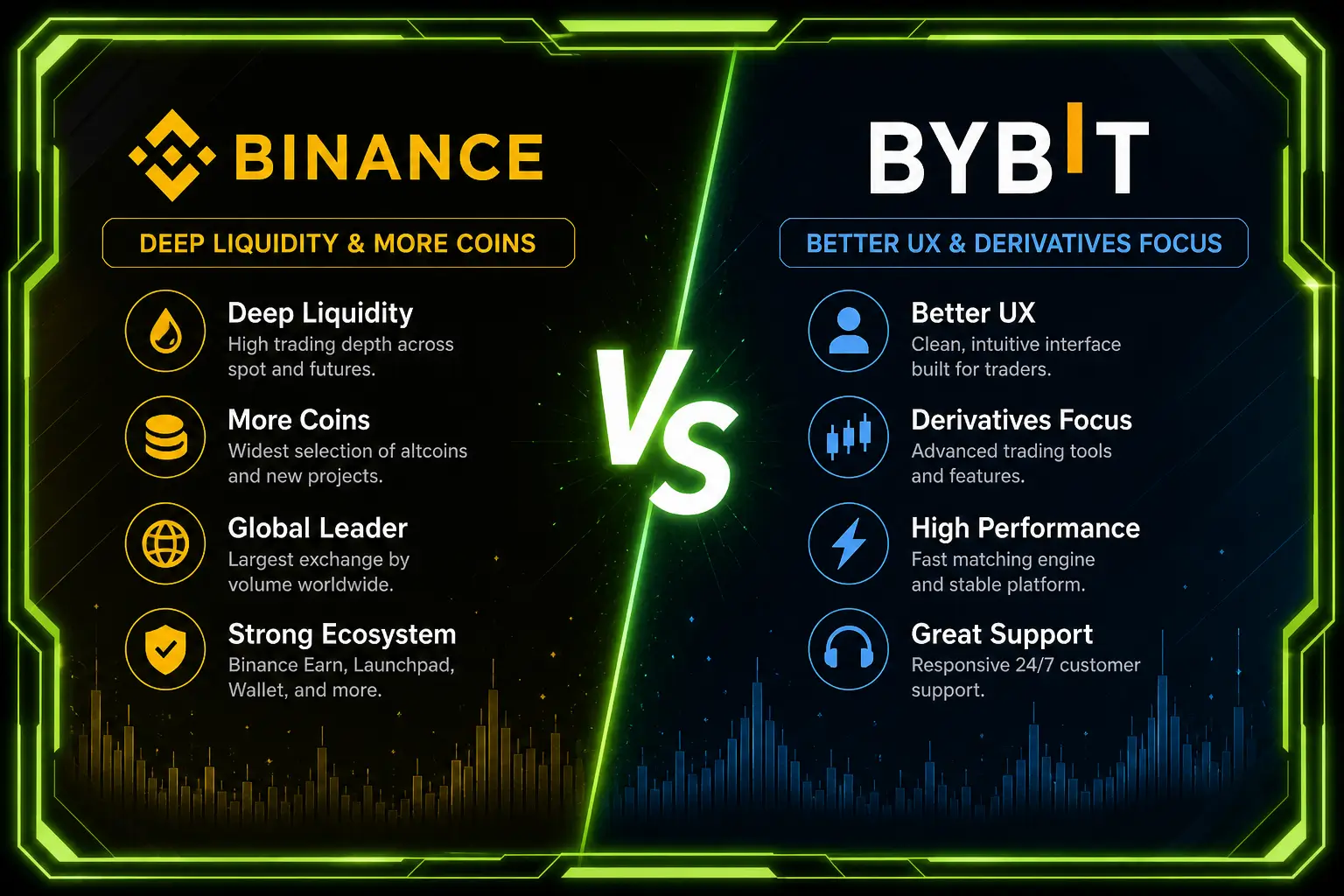
Today, two names consistently rise to the top. Bybit and Binance. One is the established giant with unmatched depth and variety. The other is the agile challenger praised for its clean experience and strong derivatives focus.
Let’s compare them honestly, feature by feature, so you can decide which one actually fits your trading style.
Trading Fees: Very Close, But Small Differences Matter
Both platforms offer competitive fees, but the details can affect your bottom line over time.
For spot trading, both charge around 0.10% for maker and taker orders. Binance gives you a nice 25% discount if you pay fees using BNB, which brings the effective rate down to about 0.075%. Bybit offers solid volume-based discounts using its own token, often reaching 20–25% for active traders.
In futures trading, Binance edges out slightly with taker fees at 0.05%, while Bybit sits at 0.055%. However, Bybit frequently runs promotions that can make it feel cheaper for regular derivatives traders.
For most beginners and mid-level traders, the difference is small. Binance wins slightly on raw taker fees, but Bybit often feels more rewarding for active users due to frequent bonuses.
Leverage and Derivatives: Where Bybit Shines
Both exchanges support high leverage, up to 125x on many popular pairs.
The real difference shows in daily use. Bybit has a much cleaner and more intuitive interface for futures trading. Many traders say it’s easier to place orders, manage positions, set stop-losses, and use copy trading features. The platform also stands out with helpful trading bots and one-click strategies.
Binance offers deeper liquidity and more advanced order types, which is valuable if you trade very large sizes.
If futures and perpetual contracts are your main focus, Bybit usually feels better for most retail traders. Binance remains stronger for those who need the absolute deepest order books.
Security and Trust
Both Bybit and Binance rank among the safest major exchanges. They use cold storage for the majority of funds, support two-factor authentication, and offer withdrawal allowlist.
Binance has a longer track record and a larger insurance fund (SAFU). Bybit has made big improvements in recent years and now publishes regular Proof of Reserves reports.
It’s hard to pullout a verdit because both are trustworthy. Binance still has a slight edge due to its size and history, but Bybit has narrowed the gap significantly.
Number of Coins and Overall Features
Binance wins clearly on variety, with over 600 spot trading pairs and a full ecosystem that includes Launchpad, Earn products, and an NFT marketplace.
Bybit takes a more focused approach, excelling in derivatives, copy trading, and user-friendly tools. Its interface feels less overwhelming for traders who want simplicity.
As regard to spot trading coverage, choose Binance for a maximum selection and a complete ecosystem. Choose Bybit if you prefer a cleaner experience focused on high-quality derivatives trading.
Beginner vs Professional Experience
For beginners, Bybit is usually easier to navigate. Its clean design and strong copy trading features help new users learn without feeling lost.
For professional traders, Binance provides deeper liquidity and more advanced tools. That said, Bybit is catching up quickly with better overall user experience.
Quick Comparison Table (Bybit vs Binance 2026)
| Feature | Binance | Bybit | Winner |
|---|---|---|---|
| Spot Trading Fees | 0.10% (0.075% with BNB) | 0.10% (strong volume discounts) | Slight edge to Binance |
| Futures Fees | 0.02% maker / 0.05% taker | 0.02% maker / 0.055% taker | Binance (taker fees) |
| Max Leverage | Up to 125x | Up to 125x | Tie |
| User Interface | Feature-rich but can feel crowded | Cleaner and more beginner-friendly | Bybit |
| Derivatives Tools | Very strong | Excellent (copy trading and bots stand out) | Bybit |
| Number of Coins | Over 600 spot pairs | Fewer but high-quality focus | Binance |
| Security & Track Record | Excellent with large insurance fund | Very good and improving rapidly | Binance |
| Best For | Variety, spot trading, large volume | Futures trading, beginners, active traders | Depends on your style |
Final Verdict and Recommendation
Both Bybit and Binance are strong platforms in 2026. However Binance remains the best choice if you want the widest selection of coins and the deepest liquidity. Bybit stands out if you prefer a cleaner interface and focus mainly on futures or derivatives trading.
My personal recommendation is simple, open accounts on both. Use Binance for spot trading and long-term holdings, and Bybit for active futures and copy trading. This combination gives you the best of both worlds without missing out on anything important.
More exchange comparisons and beginner guides in our Exchanges category.
Stay Updated
- Twitter: @FreeCoins24
- Telegram: t.me/FreeCoins24 Come hang.
FAQ: Bybit vs Binance 2026
Q1: Which exchange has lower fees in 2026?
The fees are very close. Binance has a slight advantage on futures taker fees. Bybit often wins with frequent promotions and volume discounts.
Q2: Which platform is better for beginners?
Bybit has a cleaner interface and is easier for new users, especially for futures trading.
Q3: Which exchange offers more coins?
Binance has a much larger selection of coins and trading pairs.
Q4: Which is safer?
Both are very safe. Binance has a longer track record and a larger insurance fund.
Q5: Can I use both exchanges at the same time?
Yes. Many traders keep accounts on both to enjoy the best features of each platform.
Q6: Which is better for futures trading?
Bybit is preferred by most retail traders because of its better user experience. Binance is stronger for very large volume trades.
Q7: Is KYC required on both platforms?
Both require KYC for full features and large withdrawals, but basic trading is possible without it on some accounts.
Q8: Which has better copy trading?
Bybit currently leads in copy trading features and ease of use.
Q9: Which exchange has the better mobile app?
Both apps are strong, but Bybit’s app is often praised for its simplicity.
Q10: Should I switch completely from Binance to Bybit?
Not necessarily. Test Bybit for derivatives while keeping Binance for spot trading and variety.