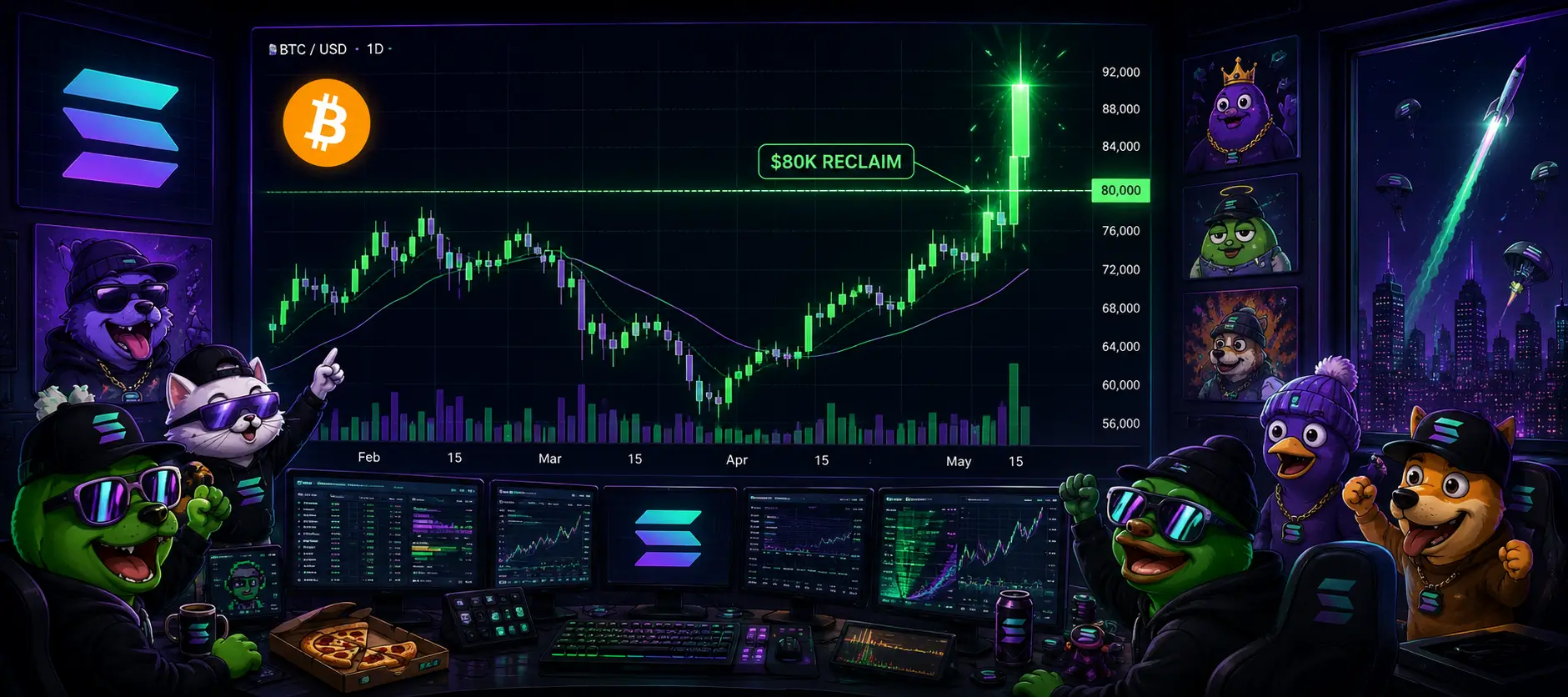
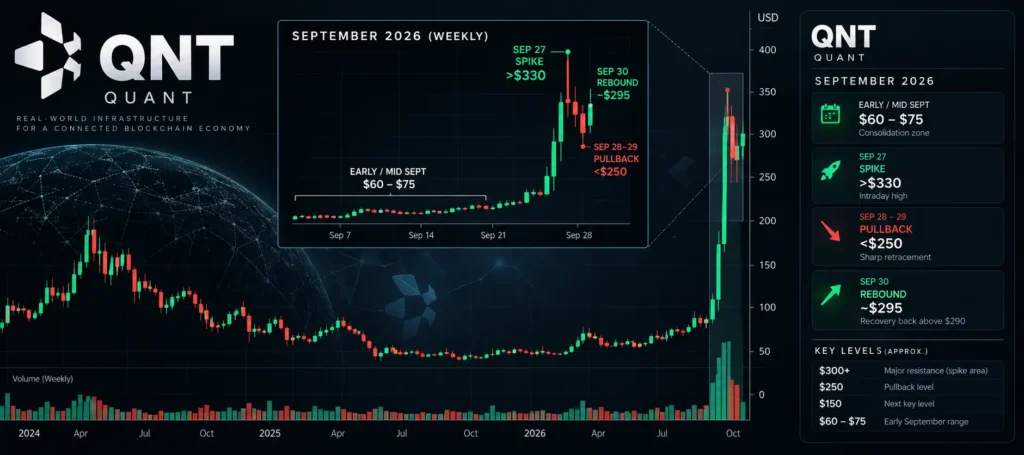
Quant Network spent years in the background. Banks tested its software and the Crypto twitter barely cared. Then this week $QNT exploded. Price jumped from the $60–$70 area toward a spike above $350, volume went vertical, and a token that felt forgotten started trending next to the usual majors.
The story people are telling is simple. Quiet bank pilots suddenly look like production. Tokenised deposits in the UK went live with real customers. The Clearing House picked Quant for a U.S. on-chain money network. And bullish posters started with comparing the moment to buying Bitcoin in 2013.
1. What the market is pricing right now
In a sharpe outlook, the week was not a normal alt bounce. Broader crypto stayed choppy.
From late last week into the weekend, the token ran over 100% . Intraday prints tagged the mid-$300s, with some venues showing a spike near $370–$375. Volume jumped from quiet tens of millions toward billion-dollar sessions. Futures open interest printed new highs too.
The most astonishing thing is that new addresses went from a few hundred on announcement day to several thousand by the peak. Frakly, that’s a repricing of an institutional story. Traders are not treating this like a meme launch. They are treating it like “banks might finally use this.” Whether that bid lasts is a different question. The tape already showed how fast the other side can appear.
After the spike, QNT gave back a large piece and is now oscillating in the high $200s as of September 30.
2. What Quant actually is
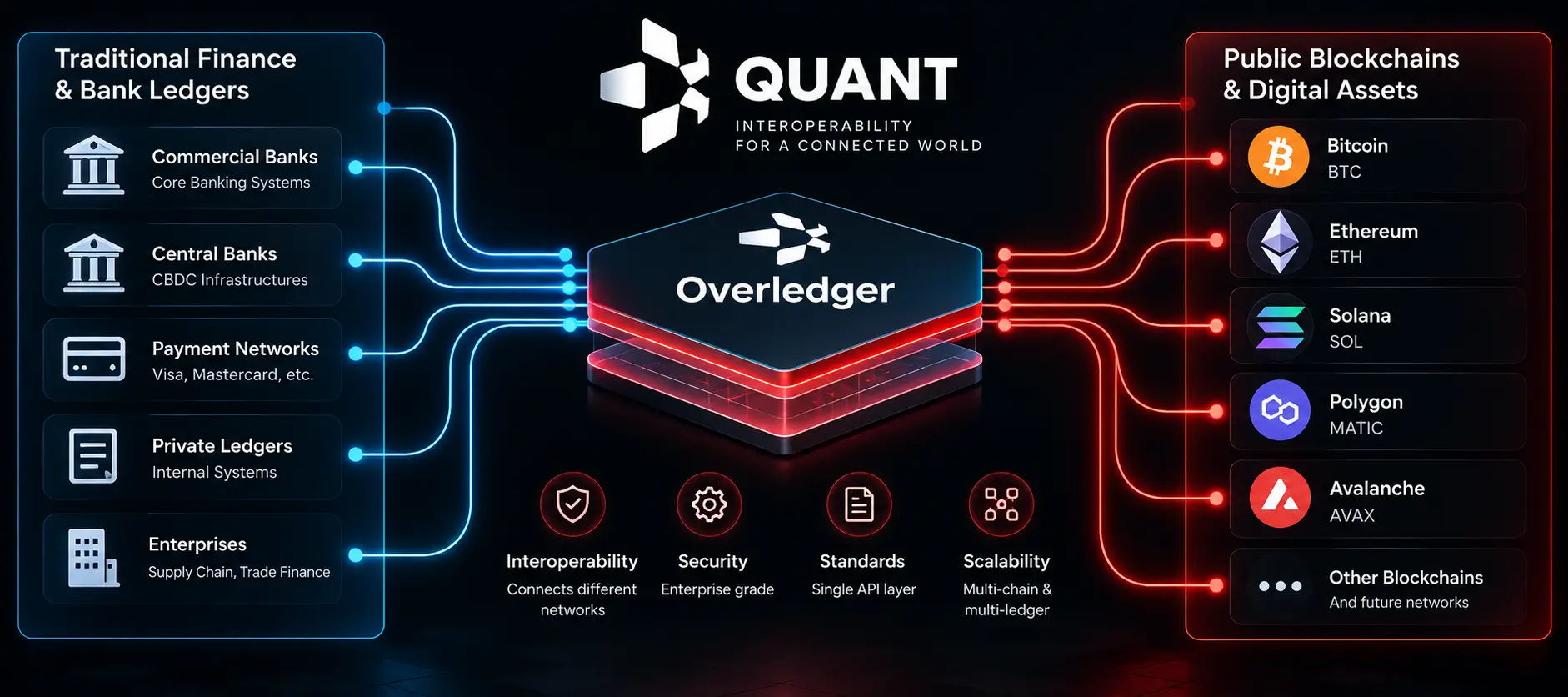
Quant is not its own Layer 1. It is a software company that sells connection and settlement tools to institutions.
Overledger:
This is the so called connect-once layer. In fact, banks and apps sit on different ledgers. However, this one sits in the middle so those ledgers can talk without each bank rebuilding the other bank’s stack.
QuantNet:
The QuantNet is the bank settlement fabric. That is the part meant for tokenised deposits moving between institutions.
Fusion
The fusion is the multi-ledger execution layer. It is how a transaction can run across more than one system and still finish as one deal.
In total sum, QNT is an ERC-20 access token. The company has a scarce supply, around 14.6 million max, with most of it already circulating. Founder Gilbert Verdian built the firm as licensed enterprise software, not as a public chain that lives or dies on retail blockspace.
So this is the whole picture; a bank can like the software and still never buy the token on Binance. That distinction matters later and retail should understand this.
3. The quiet years that suddenly matter
The core events took place in UK. Actually, Great British Tokenised Deposits program moved from tests into live customer flows last week. Citing names such as Barclays, HSBC UK, Lloyds, NatWest, Nationwide, Santander, and Monzo took part under UK Finance.
Live cases included remortgage completions, where funds lock and then release at completion, and a marketplace-style payment where money stays locked until the condition clears. Quant built the shared platform those banks used.
Then on September 24, the Clearing House selected Quant for the On-Chain Money Initiative. TCH already clears and settles more than $2 trillion a day through rails like RTP and CHIPS. The plan is an interoperable network so U.S. banks can clear and settle tokenised deposits and still touch the fiat rails they already use.
Quant also says it will offer tokenised deposits as a service to institutions that process through TCH but do not have their own stack yet.
This week Quant is still on stage. A Sibos demo with Capgemini keeps the story in front of the banking crowd while crypto is only now noticing. So here are the spines: UK live flow, U.S. clearing-house selection with Same vendor in both pictures.

4. Why banks need this layer
Banks do not share one ledger. Each one runs its own core which is the first problem for interbanks transaction.
Tokenised deposits are still a bank liability. They are not a wrapped coin that hops the way a stablecoin hops. If HSBC issues a tokenised pound, that token is still HSBC’s deposit. It cannot casually sit on another bank’s books without a settlement rule.
Atomic settlement is the second problem. In plain words, it lock the assets, check that every side can perform, then commit or abort. Delivery versus payment means the asset and the money move together. Payment versus payment means two currencies move together. Banks want that certainty without a two-day wait and a pile of emails.
These turn out to be the selling point of Quant network. It connects the private bank ledgers, orchestrate the check, tie the result back to RTP and CHIPS so the old world still balances. Banks just need to sit there and watch the playbook without moving an inch.
5. Why $QNT went viral on top of that
First, TCH plus UK live flow gave the market a sentence it could repeat.
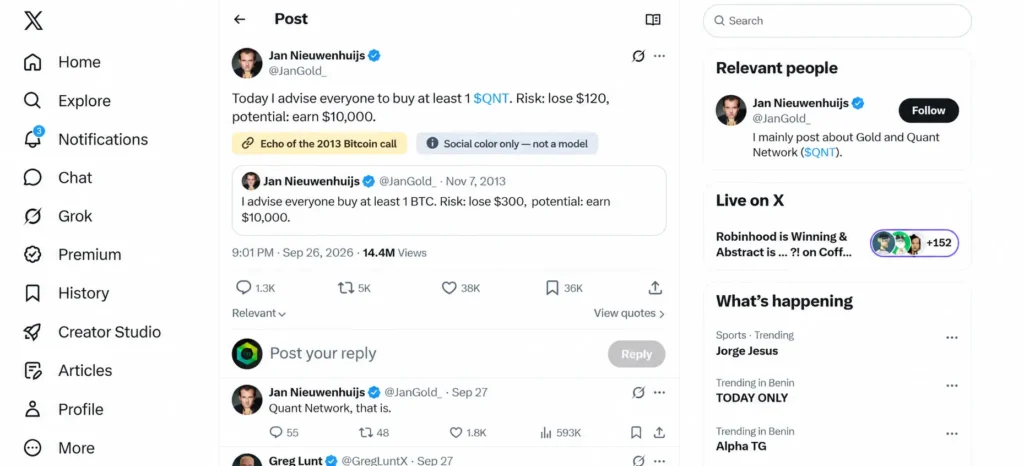
Then the float, then social color. Gold analyst Jan Nieuwenhuijs, who told people in 2013 to buy at least one Bitcoin, posted that people should buy at least one QNT. He framed it as risk $120, potential $10,000. That echo spread and prints out!
Then FOMO and liquidations of shorts follows. New addresses flooded sending the open interest over the rough. In a nutshell, the fundamentals opened the door and the leverage market coupled with the thin book kicked it.
6. The catch the market is skipping
A license can be paid in dollars. The company can lock QNT from treasury for access and never need a market buy. Adoption does not automatically create an open-market bid.
That is the tokenomics catch. Software revenue can rise while spot demand stays flat. Seeking Alpha-style token audits have been making this point for years. It is still the point.
After years of sleep, large holders woke up. Some coins moved toward exchanges. That is not automatically distribution. It is also not automatically accumulation. After a parabolic week the chart is stretched. Overbought tape plus a fading headline is how sharp pullbacks start.
None of this says the bank work is fake. It says the token and the software are two books. The market glued them together in five days. They can come unglued just as fast.
7. Crypto market outlook from here
Medium term is the real question in crypto right now. Does TCH move from a September press release to production in 2027. Do UK live flows expand past remortgage pilots. Do more bank names show up. Does any license language start to show actual QNT demand hitting the open market.
Three honest cases.
Base case: the bank story stays real, the token chops hard after the first squeeze, and the next twelve months are about delivery dates, not candles.
Bull case: more official names, Fusion usage that people can see, and license flow that actually tightens float. In that world the market keeps paying for the infrastructure narrative.
Cautious case: TCH slips, UK stays a small pilot, and traders discover that bank contracts do not need to buy QNT on the open market. The candle already priced a finished network. The network is not finished.
No $10,000 forecast lives in this outlook. That number is a social echo of a 2013 Bitcoin post. Do your own research before making any bold decision.
Conclusion
If Quant production dates slip and volume dries, the viral week will be a squeeze. If live flow expands and license language gets clearer, the quiet years will be setup.
Bookmark this page if you want a clean place to come back when TCH or Quant drops the next official note. Stay on primary sources. The story is moving faster than the comments section.
More market structure pieces in our Market Insights category.
Stay Updated
For daily alerts, honest analysis, and the newest airdrop opportunities, follow us on X at @FreeCoins24 and join the conversation on Telegram at t.me/FreeCoins24.
This is not financial advice. A bank tech win does not mean the token must go up. Crypto is volatile. Do your own research.
FAQ: Quant Network and the QNT Rally
What is Quant Network?
A software company that sells interoperability and settlement tools so banks and ledgers can connect. It is not a public L1 like Ethereum.
Is QNT a blockchain?
QNT is an ERC-20 token used as an access and utility token around Quant’s software.
What is Overledger?
Quant’s connect-once layer. It sits between different bank systems and chains so they can pass transactions without rebuilding each other.
What did The Clearing House announce?
On September 24, 2026 it selected Quant to power the On-Chain Money Initiative, a planned U.S. network for clearing and settling tokenised deposits, with access targeted for H1 2027.
What are tokenised deposits?
Digital versions of normal bank deposits. They stay a claim on the issuing bank. They are not the same thing as a public stablecoin.
What is atomic settlement?
A deal that either fully completes or fully cancels. Assets and money move together, or nothing moves.
Does bank adoption buy QNT on the open market?
Not automatically. Licenses can be paid in dollars while QNT is locked from treasury. That is the main token catch.
Why did the price jump so fast?
A bank headline hit a thin float, then social posts, new retail addresses, and short covering stacked on top of each other.
Is the $10,000 post a real target?
It is a social risk-reward line from Jan Nieuwenhuijs, echoing his 2013 Bitcoin note. It is not a published valuation model.
What should readers track after the rally?
Official TCH updates, UK live-flow expansion, license payment language, exchange inflows, and whether volume stays after the headline fades.