
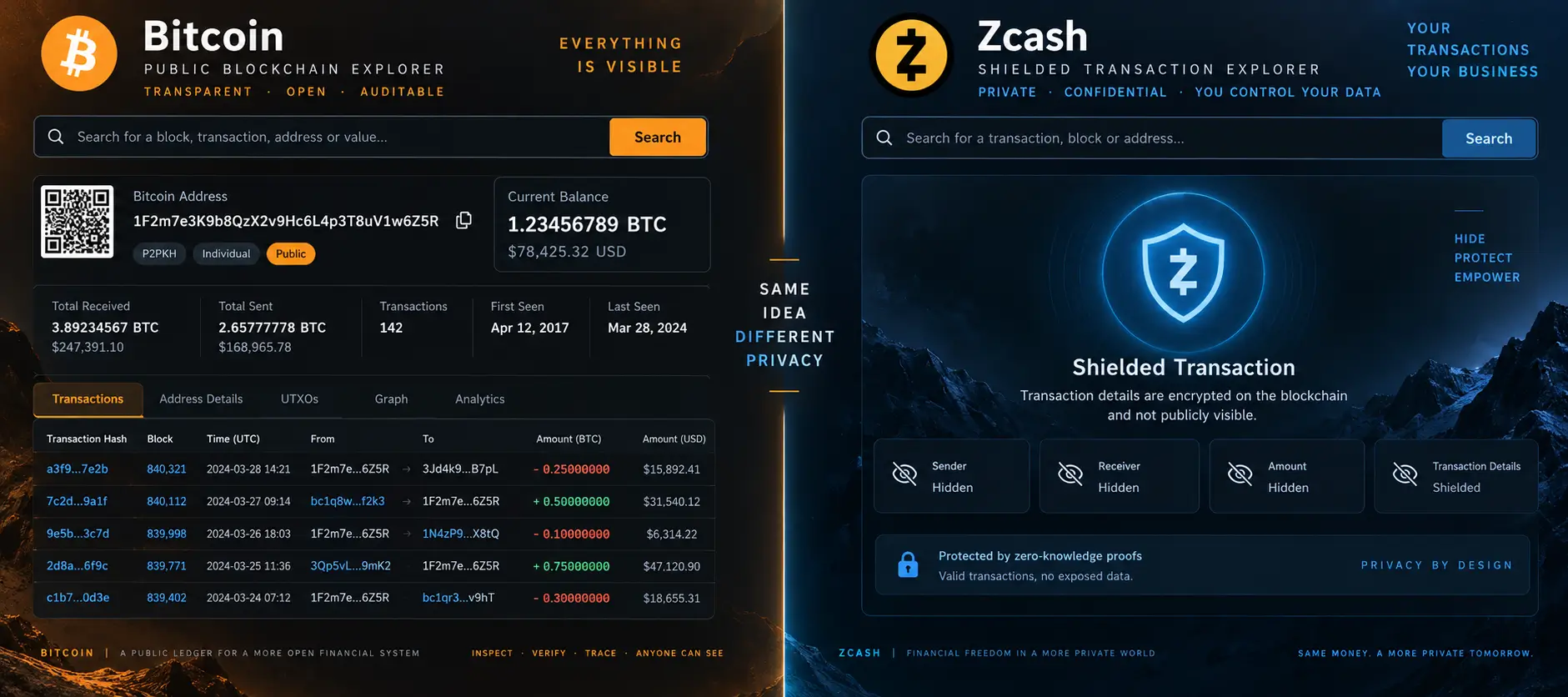
Blockchain ledger is a big innovation and Crypto sold transparency as a feature.
Every transfer was public. Every whale wallet could be tracked. Every treasury move showed up on a dashboard within minutes.
Other factors include AI agents. They can detect vulnerabilities and exploit dapps, creating open doors in any onchain active wallets. It can also control self made wallets and front-run anyone. Worser, ledgers are getting hacked.

People began to notice that a fully public ledger is also a fully public balance sheet. Transparency in the era of AI agents are no longer a feature but a matter.
Then Zcash did what privacy coins are supposed to do when that mood flips. ZEC jumped about 28% on the week and push its market cap near $17 billion.
Why Transparency Started to Feel Like a Problem
Bitcoin and Ethereum still dominate because they are easy to audit. That same quality is now the friction.
Institutions already use dark pools in traditional markets for this reason. They do not want the whole book watching the order.
Crypto’s original answer was to keep everything visible or transparent. However, Zcash’s answer is different: keep the money sound, hide the details as please you.
That is the core narrative behind the $1,000 break. People are not only buying a chart. They are buying the idea that private money can exist without giving up a Bitcoin-style 21 million cap.
What Actually Pushed ZEC Through $1,000
Three forces stacked at the same time.
1. A real US product landed.
Grayscale converted its old Zcash Trust into a spot ETF, ZCSH, listed on NYSE Arca on August 25, 2026. Assets moved from around $304 million at conversion toward $414 million within days. Brokerage accounts could now buy ZEC exposure without touching a self-custody wallet.
2. The derivatives market got squeezed.
Open interest in ZEC perps jumped toward $2.4 billion. When price cleared $1,000, more than $34 million in shorts were liquidated. That forced buying accelerated the breakout.
3. The privacy story got cleaner.
Shielded supply has climbed to about 4.86 million ZEC, close to 29% of circulating coins. After the Ironwood upgrade, Zcash could argue it still offers private transfers while keeping supply more verifiable than critics claimed.
The Response Trade, Not Just a Pump
Onchain analytics became a product and then regulation asked exchanges to collect more user data. Then AI made surveillance cheaper, sending ZEC vertical and higher.
In other hands, Tyler Winklevoss called Zcash “AI-proof private money.” Balaji has treated the network as infrastructure that still has to scale. Naval’s older line still fits the mood as Bitcoin hedges the dollar, Zcash hedges Bitcoin.
However, this doesn’t make ZEC risk-free becayse privacy coins live under constant policy pressure. Zcash also carries a known historical issue around shielded-pool integrity.Eventhough, the Ironwood upgrade fixes this, the technology is still evolving.
The fact is that, the market is still pricing a narrative as much as it is pricing a finished product. It doesn’t care about the tech integrity.
What the Chart Is Saying Now
Support is sitting near $985–$1,005. A hold there keeps the breakout intact.
The next upside markers traders are watching are $1,100 and then the $1,300 area.
A failure back under $1,000 would turn this into another liquidity spike instead of a regime change.
The bigger tell is not the next $100. It is whether shielded usage and ETF flows keep rising after the headline fades. Pumps die. Product demand does not have to.
Final Thoughts
ZEC hitting $1,000 is the market answering that shift in the most direct way it knows.
The open question is whether this is a one-week squeeze or the start of private money getting priced like a real category again.
More market structure and narrative pieces in our Market Insights category.
Stay Updated
For daily alerts, honest analysis, and the newest airdrop opportunities, follow us on X at @FreeCoins24 and join the conversation on Telegram at t.me/FreeCoins24.
FAQ:
When did Zcash hit $1,000?
On September 4, 2026, ZEC crossed $1,000 for the first time in nearly a decade.
How high did it go?
Intraday prints ran from about $1,020 to a little over $1,045 depending on the venue.
What caused the rally?
Grayscale’s ZCSH ETF, a short squeeze, and a stronger privacy narrative hit at the same time.
What is ZCSH?
Grayscale’s US-listed spot Zcash ETF, launched August 25, 2026 on NYSE Arca.
Why does transparency feel like a liability now?
Public wallets are easy to track, front-run, tax and analyze with AI. That visibility has a cost.
Is Zcash fully private by default?
No. It supports transparent and shielded addresses. The bull case depends on more coins moving into shielded pools.
How much ZEC is shielded?
Around 4.86 million ZEC, close to 29% of circulating supply at the time of the breakout.
Is this a new all-time high?
No. ZEC is still far below its 2016 peak, even after reclaiming $1,000.
What levels matter next?
$985–$1,005 as support, then $1,100 and $1,300 as upside targets if the breakout holds.
Is this financial advice?
No. Privacy coins are volatile and politically sensitive. Do your own research and size positions carefully.